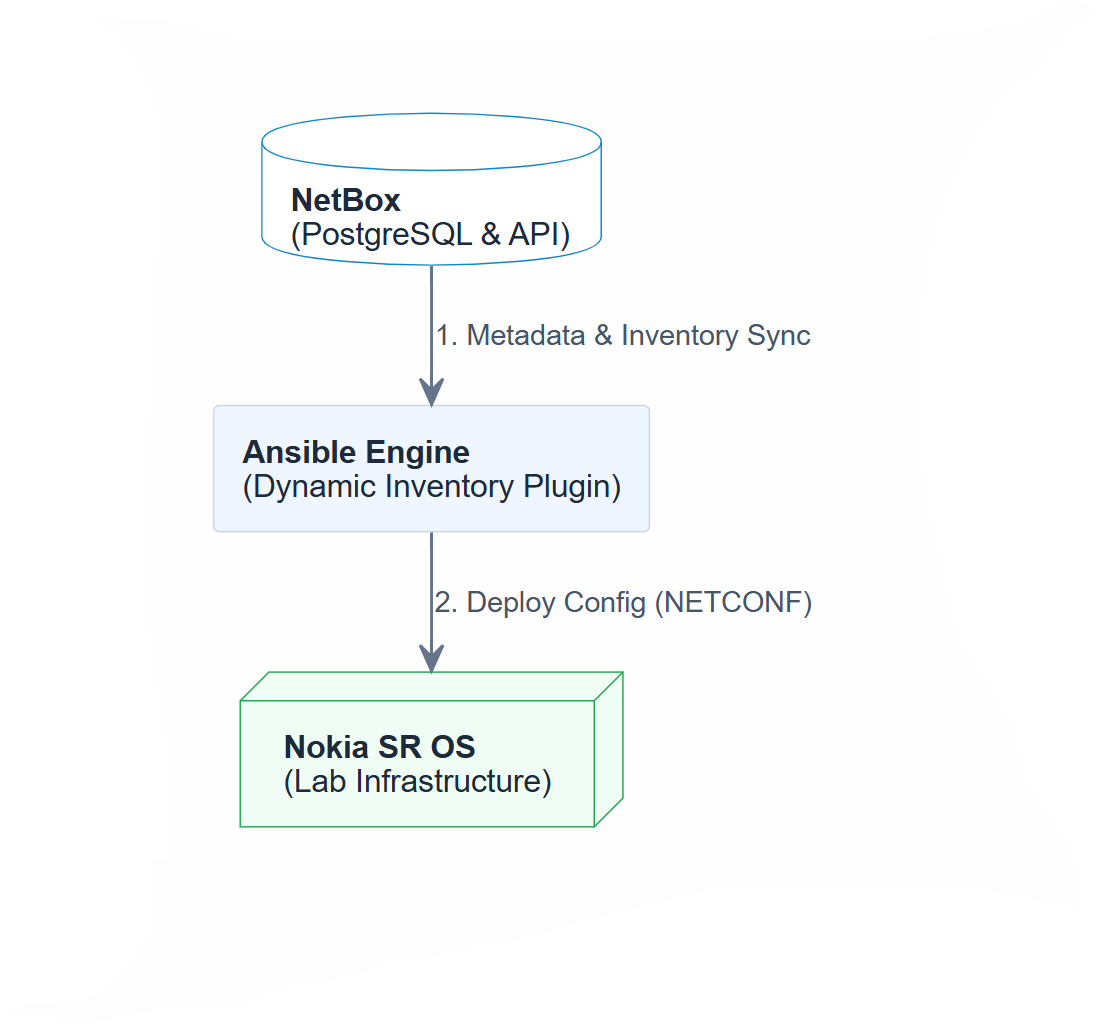
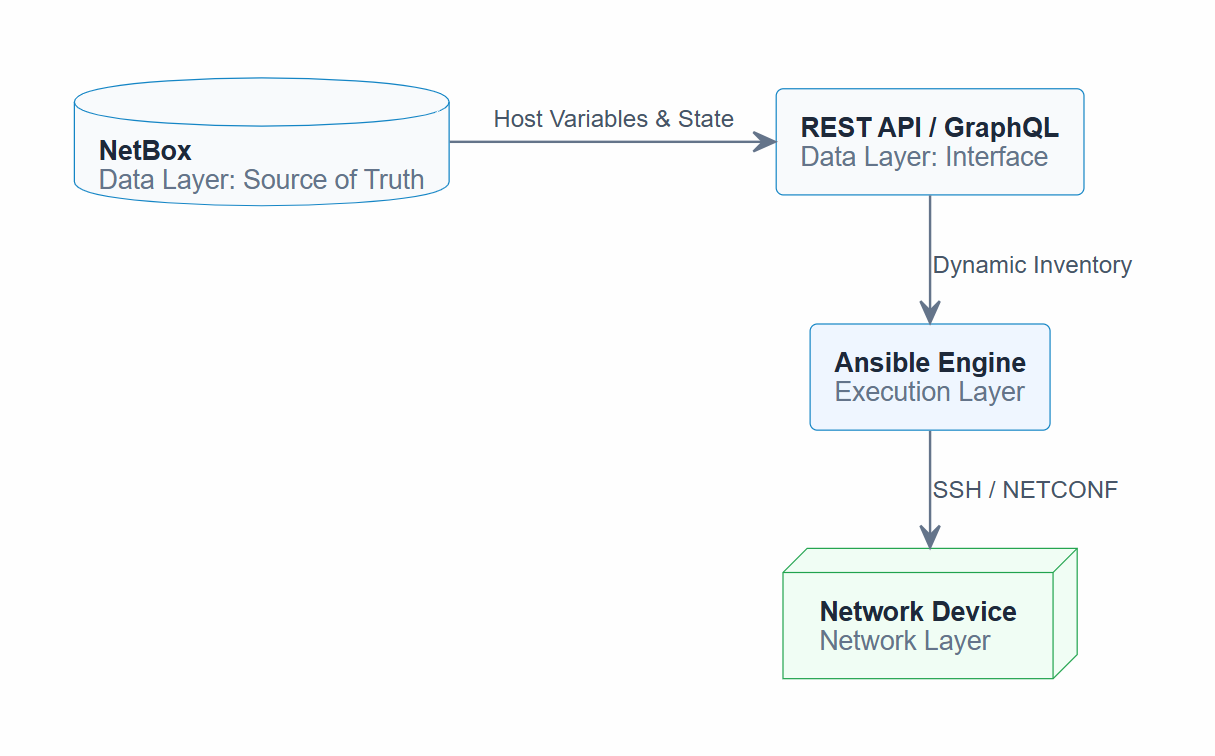
NetBox is an open-source Infrastructure Resource Management tool designed to act as that single source of truth. It decouples your network state variables from both your configuration playbooks and your physical hardware.
In this guide, we will deploy NetBox locally on Ubuntu and model a very simple set of infrastructural data.
graph LR subgraph Truth [Data Layer] NB[(NetBox)] -- "Host Variables & State" --> API[REST API / GraphQL] end subgraph Logic [Execution Layer] API -- "Dynamic Inventory" --> Ans{Ansible Engine} end subgraph Infrastructure [Network Layer] Ans -- "SSH / Netconf" --> R1[Nokia 7750 SR-1] Ans -- "SSH / Netconf" --> R2[Multi-Vendor Edge] end style NB fill:#2d3748,stroke:#4a5568,stroke-width:2px,color:#fff style Ans fill:#1a202c,stroke:#e2e8f0,stroke-width:2px,color:#fff style R1 fill:#2b6cb0,stroke:#4299e1,stroke-width:2px,color:#fff style R2 fill:#2b6cb0,stroke:#4299e1,stroke-width:2px,color:#fff1. System Architecture & Dependencies Before provisioning, we must understand NetBox’s application layers. It is not a single monolith; it is an ecosystem of decoupled components that work together over defined boundaries:
...